

For decades, Governance, Risk, and Compliance (GRC) has been a discipline defined by retrospection. Audits looked back at what happened, risk assessments relied on historical data, and compliance was a "check-the-box" exercise often disconnected from the daily reality of cyber threats.
Driven by Agentic AI, predictive analytics, and autonomous control monitoring, the future of GRC is not about reporting on the past—it is about forecasting the future. This article explores how emerging technologies are rewriting the playbook for cybersecurity risk management.
1. From Generative to "Agentic" AI
While Generative AI (GenAI) revolutionised content creation and summarisation, the next frontier is Agentic AI. Unlike standard LLMs that wait for a prompt to act, AI agents are autonomous systems capable of reasoning, planning, and executing complex workflows without constant human intervention.
In a GRC context, these "digital coworkers" will transform risk management:
-
Autonomous Remediation: Instead of just flagging a misconfigured firewall or a policy violation, an AI agent can detect the issue, cross-reference it with the acceptable risk appetite, and deploy a patch or configuration change automatically—only escalating to humans if the action exceeds its authority threshold.
- Dynamic Policy Management: Agentic AI can continuously scan global regulatory updates (e.g., new SEC cyber rules or EU AI Act amendments) and automatically draft updates to internal policy documents, highlighting exactly which operational controls need to change.
2. The Era of Predictive GRC
Traditional risk management is reactive. Predictive GRC uses machine learning to anticipate control failures before they result in a breach.
How It Works:
-
Behavioural Forecasting: By analysing vast datasets of user behaviour, network traffic, and historical incident logs, AI models can predict which departments or specific users are most likely to cause a compliance breach in the next quarter.
-
Vulnerability Correlation: Rather than treating all vulnerabilities equally, predictive models correlate threat intelligence (active exploits in the wild) with business context (asset criticality) to forecast the financial impact of a specific risk, allowing CISOs to prioritise based on "Value at Risk" (VaR).
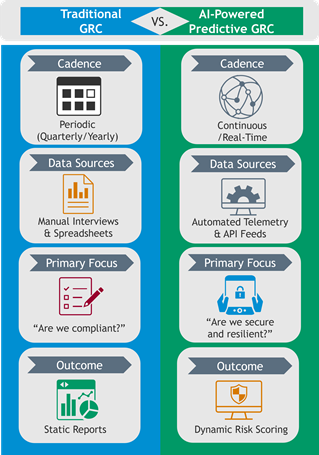
Figure 1: Traditional GRC vs. AI-powered predictive GRC
3. Continuous Control Monitoring (CCM)
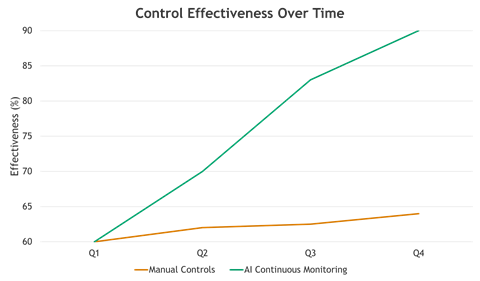
Figure 2: Continuous Control Monitoring Over Time
AI enables Continuous Controls Monitoring (CCM), detecting control degradation and design gaps between audit cycles. This accelerates compliance maturity and aligns strongly with ISO 27001, NIST CSF 2.0, and regulatory expectations.
-
Real-Time Evidence Collection: AI connectors hook directly into cloud environments (AWS, Azure), HR systems, and endpoint detection tools. They automatically harvest evidence (screenshots, logs, configurations) to prove compliance, eliminating the manual "audit fatigue" that plagues security teams.
- The "Trust Vault": Emerging platforms are creating centralized "Trust Vaults" where AI continuously verifies security controls. This allows organisations to share a live, sanitized view of their security posture with customers and partners, replacing static PDF security questionnaires.
4. The Double-Edged Sword: New Risks and Ethics
The integration of AI into GRC is not without peril. As we automate governance, we introduce new layers of "meta-risk"— the risk that the risk management system may fail.
-
The "Black Box" Problem: If an AI model denies a vendor contract based on a predicted risk score, the organisation must be able to explain why. Regulators are increasingly demanding Explainable AI (XAI) to ensure automated decisions are transparent and free from algorithmic bias.
-
Hallucinations in Compliance: GenAI models can "hallucinate" non-existent regulations or incorrect legal interpretations. "Human-in-the-loop" governance remains critical to validate AI outputs before they become binding policy.
- Adversarial AI: Cybercriminals are using the same AI tools to automate attacks. GRC systems must now account for "AI-on-AI" warfare, where defensive AI agents must outmanoeuvre offensive AI bots attempting to poison data or bypass controls.
5. The Evolving Role of the GRC Professional
Will AI replace the GRC analyst? No, but it will fundamentally change their job description. The role is shifting from Data Gatherer to Risk Strategist.
-
Less time spent chasing stakeholders for screenshots, filling out spreadsheets, and mapping controls manually.
- More time spent interpreting AI-driven risk forecasts, advising the board on strategic trade-offs, and managing the ethical governance of the AI systems themselves.
Conclusion: The Proactive Shift
The future of cybersecurity risk management is not about building higher walls; it is about building smarter, self-healing ecosystems. By embracing Agentic AI and predictive analytics, organisations can move from a posture of defensive compliance to offensive resilience. The question for leaders is no longer "Are we compliant today?" but "What will our risk posture look like tomorrow?"
References:
-
Archer IRM. (2025, August 14). Redefining risk and accountability in the age of Agentic AI. Archer Integrated Risk Management. https://www.archerirm.com/post/redefining-risk-and-accountability-in-the-age-of-agentic-ai
-
Cyber Sierra. (2025, November 20). Top AI-powered GRC trends to watch in 2026. Cyber Sierra. https://cybersierra.co/blog/ai-grc-trends-2026/
-
Diligent. (2025, November 11). 6 AI trends for GRC professionals in 2026. Diligent Corporation. https://www.diligent.com/resources/6-ai-trends-for-grc-professionals-in-2026/
-
Gartner. (2025, October 21). Gartner identifies the top strategic technology trends for 2026. Gartner Press Release. https://www.gartner.com/en/newsroom/press-releases/2025-10-21-gartner-identifies-the-top-strategic-technology-trends-for-2026
-
Hyperproof. (2025, December 1). The future of AI in GRC: From reactive oversight to proactive intelligence. Hyperproof Resources. https://hyperproof.io/resource/the-future-of-ai-in-grc/
-
MetricStream. (2026, January 5). Top 10 risk and compliance resolutions for GRC leaders in 2026. MetricStream Insights. https://www.metricstream.com/blog/top-grc-trends-agentic-ai-enterprise-cyber-grc-2026.html
-
Onyebuchi, A., & Gupta, S. (2025). AI-powered GRC: Enhancing regulatory compliance and risk resilience in evolving cyber threat landscapes. World Journal of Advanced Research and Reviews (WJARR), 26(2), 415-428. https://doi.org/10.30574/wjarr.2025.26.2.2778
-
Stanford University. (2025). The AI index 2025 annual report. Stanford Institute for Human-Centered AI (HAI). https://hai.stanford.edu/research/ai-index-report-2025